 EN
EN
 RU
RU
To answer the question of which material is best for seals, let’s compare the properties of thermoplastic elastomers (TPEs) and rubbers, and determine when rubber is more reliable and cost-effective, and when TPEs offer advantages.
It is important to note that both TPEs and rubbers are not single substances, but classes of polymer compounds.
Currently, two main types of polymer compounds are used to manufacture window, door, and other seals for plastic and aluminum structures:
- Rubbers (vulcanized with additives);
- Thermoplastic elastomers (TPEs).
1. EPDM Rubber (Ethylene-Propylene-Diene Monomer)
To simplify the vulcanization process, a third monomer, ethylidene norbornene (ENB), is added to the molecular chain (Fig.1). EPDM rubber can be vulcanized using sulfur or resin compounds. The chemical vulcanization process creates cross-linking of the rubber macromolecules, forming a three-dimensional molecular network (Fig. 2). Thanks to this cross-linking, rubber acquires the ability to recover from mechanical deformation (impact, stretching, etc.).

High-quality EPDM rubber used in seal production is imported into Russia from Western Europe (Germany, Italy) and Asia (South Korea, Taiwan, Japan). As a result, the cost of seals made from pure EPDM is high and uncompetitive. In Russia, imported EPDM compounds contain no more than 30% actual rubber; the remaining 70% consists of fillers (mainly carbon black) and softeners (oils).
Identification: EPDM rubber leaves a black streak on white paper. Its precise composition can only be determined in a laboratory.
Rubber production is energy-intensive and requires continuous vulcanization after extrusion, which further increases the cost. Cheap EPDM seals with little rubber content have poor strength, elasticity, and durability. In addition, the chemicals used for EPDM vulcanization make it unsuitable for contact with food products.
2. Silicone-Based Rubbers
Silicone rubbers are obtained from organosilicon compounds (Si-based). Raw silicone rubber is more expensive than EPDM. Thanks to their structure (Fig. 3), silicone-based rubbers have even higher resistance to aging and flexibility at sub-zero temperatures.
Production requires peroxide vulcanization systems, which are significantly more expensive than sulfur or resin systems used for EPDM. As a result, silicone seals are applied only in highly specialized areas, where extremely low or high temperatures are involved. For windows, doors, or aluminum systems, their use is economically impractical.
Advantages of EPDM seals:
- Excellent elastic properties;
- High resistance to ozone and UV;
- Strong deformation and strength characteristics;
- Wide operating range;
- Retain elasticity below –40 °C.
Disadvantages of EPDM seals:
- High cost;
- Low production efficiency;
- Colored seals are more expensive (due to the absence of carbon black);
- Cannot be welded when heated;
- Not suitable for food contact.
The polymer processing industry is rapidly developing, with thermoplastic elastomers replacing low-tech rubbers. This trend is clearly visible in developed European and Asian markets.
Thermoplastic Elastomers (TPEs)
The polymer processing industry is developing rapidly, with TPEs increasingly replacing low-tech rubbers. This trend is especially visible in Europe and Asia.
1. PVC (Plasticized Polyvinyl Chloride)
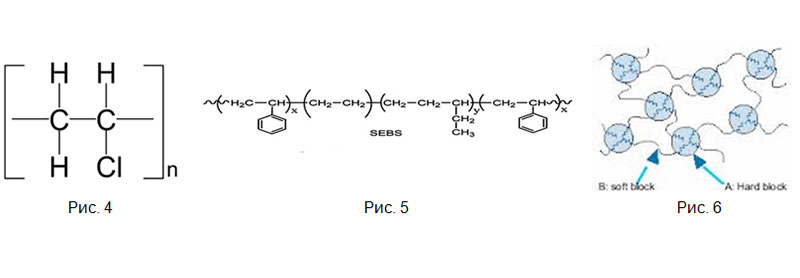
Invented nearly 200 years ago, PVC (Fig. 4) could not be widely used for a long time because it degraded quickly during processing. PVC decomposes under heat, releasing hydrogen chloride, and is also subject to UV degradation.
In pure form, PVC is rigid (used, for example, for window frames). Elasticity is achieved by adding 40–60% plasticizers. Over time, plasticizers leach out, causing shrinkage and reducing the seal’s effectiveness. A typical soft PVC formulation contains up to 10% stabilizers (often lead salts), making it non-eco-friendly and short-lived.
PVC also becomes rigid at low temperatures, which complicates installation and can cause cracking in cold weather. However, PVC remains the cheapest thermoplastic elastomer. In practice, the lowest-cost seals are usually made from PVC—with all the associated drawbacks.
More modern thermoplastic elastomers are blended thermoplastic elastomers. A small amount of plastic makes the thermoplastic elastomer processable at high temperatures, while the rubber makes the material elastic like rubber. Specifically, two types of thermoplastic elastomer are used to make seals:
2. TPE-V (Dynamically Vulcanized Thermoplastic Elastomer)
TPE-V contains EPDM, plastic, fillers, and softeners. Essentially, it is vulcanized EPDM rubber with thermoplastic properties due to its plastic component. Vulcanization occurs dynamically, during mixing in a twin-screw extruder.
Thus, TPE-V has properties similar to EPDM rubbers but with slightly lower elasticity due to the plastic fraction.
3. TPE-S (SEBS-Based Thermoplastic Elastomer)
A more recent development is TPE-S, based on styrene-ethylene-butylene-styrene (SEBS) block copolymers (Fig. 5). Structurally, SEBS is similar to EPDM, but instead of chemical vulcanization, it undergoes reversible “physical vulcanization” (Fig. 6).
Unlike rubber, which cannot be reprocessed after vulcanization, SEBS softens at processing temperatures, making it recyclable. SEBS is resistant to ozone and UV, requires no chemical vulcanization additives, and is environmentally friendly. It can also be safely used for food packaging and medical products.
In conclusion, the following advantages of TPE-S (TPE-based SEBS) seals are worth highlighting:
- Cost-effective;
- Good elasticity;
- High resistance to ozone and UV;
- Strength comparable to rubber;
- Wide application range (windows, doors, food packaging, medical devices);
- Remain elastic below –40 °C;
- Easily welded;
- High-tech, low-waste production;
- Colored seals cost almost the same as black ones.
Drawback: Elastic properties are slightly inferior to natural rubber.
Conclusion
All materials discussed meet GOST 30778-2001 requirements for elastomeric sealing gaskets for windows and doors. Each material has its own price segment, but in terms of the balance between performance and cost, SEBS-based TPE seals (TPE-S) have recently become the most competitive solution in the market.
